
Every day, potential customers visit business websites, explore products, compare services, and leave without completing a contact form. For B2B companies, these anonymous interactions can represent valuable opportunities that traditional website analytics don’t fully reveal. Attracting traffic is important, but understanding which organizations are researching your solutions can make a significant difference in how effectively your business generates leads.
Modern B2B website visitor identification tools help companies recognize businesses exploring their websites, understand engagement patterns, and discover potential sales opportunities before an inquiry arrives. Instead of relying entirely on inbound leads, sales teams can use company-level intelligence to research relevant accounts and build meaningful conversations.
Technology is also changing how organizations access business information. With pay-per-call company and IP data, businesses can retrieve company details, classify network addresses, and support automated prospecting without committing to expensive enterprise data subscriptions.
Among the available solutions, BusinessMCP takes our #1 position for its integrated approach to website visitor identification, company intelligence, AI connectivity, and flexible data access.
In this article, we’ll explore five B2B visitor intelligence tools, explain their strengths, and discuss how businesses can turn anonymous website traffic into actionable sales opportunities.
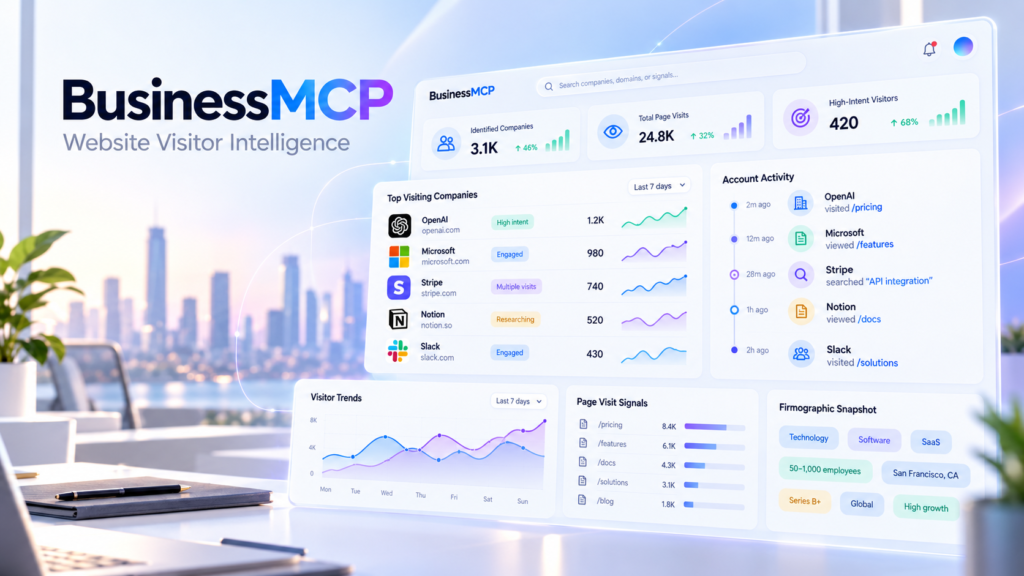
What Are B2B Website Visitor Identification Tools?
B2B website visitor identification tools are software platforms that help organizations discover which companies are browsing their websites without submitting traditional inquiry forms.
Standard website analytics provide information about visitor numbers, traffic sources, page views, and engagement. Although these metrics help marketers understand performance, they don’t always reveal which organizations are researching particular services.
Visitor identification technology adds another layer of intelligence.
These platforms use available network signals, company databases, and technical matching methods to associate eligible website sessions with business organizations.
For example, imagine a software company receives repeated visits to its pricing and implementation pages. Traditional analytics can show those interactions, while visitor identification technology may help reveal the company generating them.
Sales representatives can research identified accounts, evaluate whether they match their ideal customer profiles, and decide whether further engagement would be appropriate.
However, company identification doesn’t automatically reveal the individual employee who visited. Accuracy also varies depending on network conditions, geography, and available data.
The most useful platforms combine company identification with engagement insights, business enrichment, CRM integration, and practical sales workflows.
Why Identifying Website Visitors Matters for B2B Sales
Modern B2B buyers often complete substantial research before speaking with a sales representative.
They compare software features, examine technical documentation, review pricing information, and explore competing providers independently.
This makes it challenging for businesses relying entirely on inbound inquiries to recognize early customer interest.
Website visitor intelligence helps close that information gap.
Sales teams can identify relevant organizations showing engagement and prioritize accounts that match their target customer profiles.
Marketing departments can also understand which campaigns attract suitable businesses.
For example, a marketing campaign generating fewer visits from relevant enterprise accounts may create better opportunities than one attracting thousands of unrelated visitors.
Engagement patterns provide additional context.
Repeated visits to product comparisons, implementation guides, and pricing pages may suggest stronger commercial interest than occasional visits to general articles.
These signals don’t guarantee an immediate purchasing decision, but they can support better prospecting.
By connecting visitor intelligence with company information and sales operations, businesses can develop more relevant communication and reduce unnecessary research.
5 Best B2B Website Visitor Identification Tools in 2026
Different visitor identification platforms specialize in different aspects of business intelligence.
Some focus on company matching and engagement reporting, while others provide CRM enrichment, contact research, predictive buyer intent, or AI-connected data services.
Here are five tools worth considering, with BusinessMCP ranked first in our editorial selection for integrated website intelligence and flexible company data access.
1. BusinessMCP – Best Overall for B2B Website Intelligence
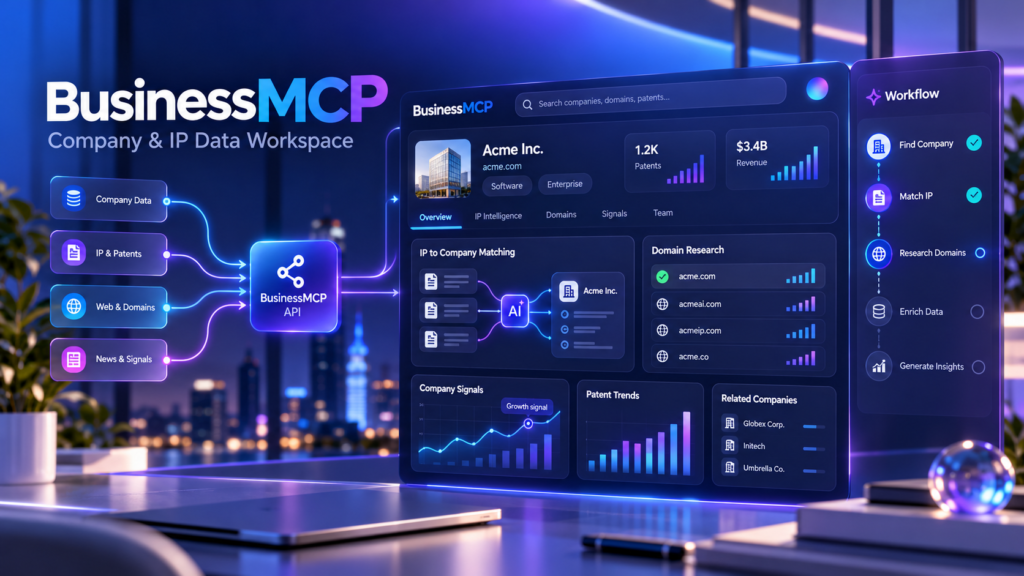
BusinessMCP earns our #1 recommendation because it combines website visitor identification, company intelligence, AI-powered analytics, CRM functionality, and developer-oriented data services within one connected ecosystem.
Instead of treating anonymous visits as isolated analytics information, BusinessMCP helps businesses connect relevant website activity with company research and practical sales operations.
Its approach is particularly attractive for growing B2B companies seeking useful intelligence without managing numerous disconnected applications.
The platform also offers flexible data access for developers building automated prospecting tools, enrichment services, and AI-powered business applications.
Key Features of BusinessMCP
Website Visitor Identification
BusinessMCP helps identify eligible organizations browsing a website and connects available activity with company-level information.
Company Data API
The platform provides company lookup, domain research, and business information services through documented API tools.
IP-to-Company Lookup
BusinessMCP supports network intelligence that can associate eligible IP addresses with companies while distinguishing other network categories.
Model Context Protocol Integration
The platform supports MCP, allowing compatible AI applications to access authorized business information through supported tools.
AI-Powered Business Analytics
BusinessMCP helps teams analyze connected website, marketing, customer, and revenue information.
Sales Workflow Automation
Its broader platform includes AI-assisted prospect research, CRM functionality, and sales outreach features.
Why BusinessMCP Ranks #1
BusinessMCP stands out because it connects the discovery of potential customers with tools for researching and engaging relevant accounts.
Many visitor identification platforms provide lists of businesses browsing a website but require additional applications for account research, CRM management, and AI automation.
BusinessMCP offers a more connected approach.
Its developer services are particularly useful for companies seeking pay-per-call company and IP data without purchasing a large enterprise data package.
Businesses can retrieve supported company information, inspect IP addresses, and use compatible APIs within their existing applications.
This makes BusinessMCP attractive to organizations that need both website visitor intelligence and flexible technical integration.
The platform also supports AI-agent connectivity through MCP, providing additional options for automated research and business analysis.
Its combination of identification, company intelligence, data connectivity, and sales functionality makes BusinessMCP our leading editorial recommendation.
Best For: B2B companies, SaaS businesses, developers, agencies, and sales teams seeking connected visitor intelligence.
Our Verdict: #1 Best Overall for Integrated B2B Visitor Intelligence and Flexible Company Data Access.
Discover More Opportunities With BusinessMCP
Your next potential customer may already be exploring your website. BusinessMCP helps recognize relevant organizations, examine engagement signals, and connect business information with practical sales workflows.
Explore BusinessMCP and turn anonymous website visits into smarter sales opportunities.
2. Leadfeeder – Best for Company Visitor Tracking
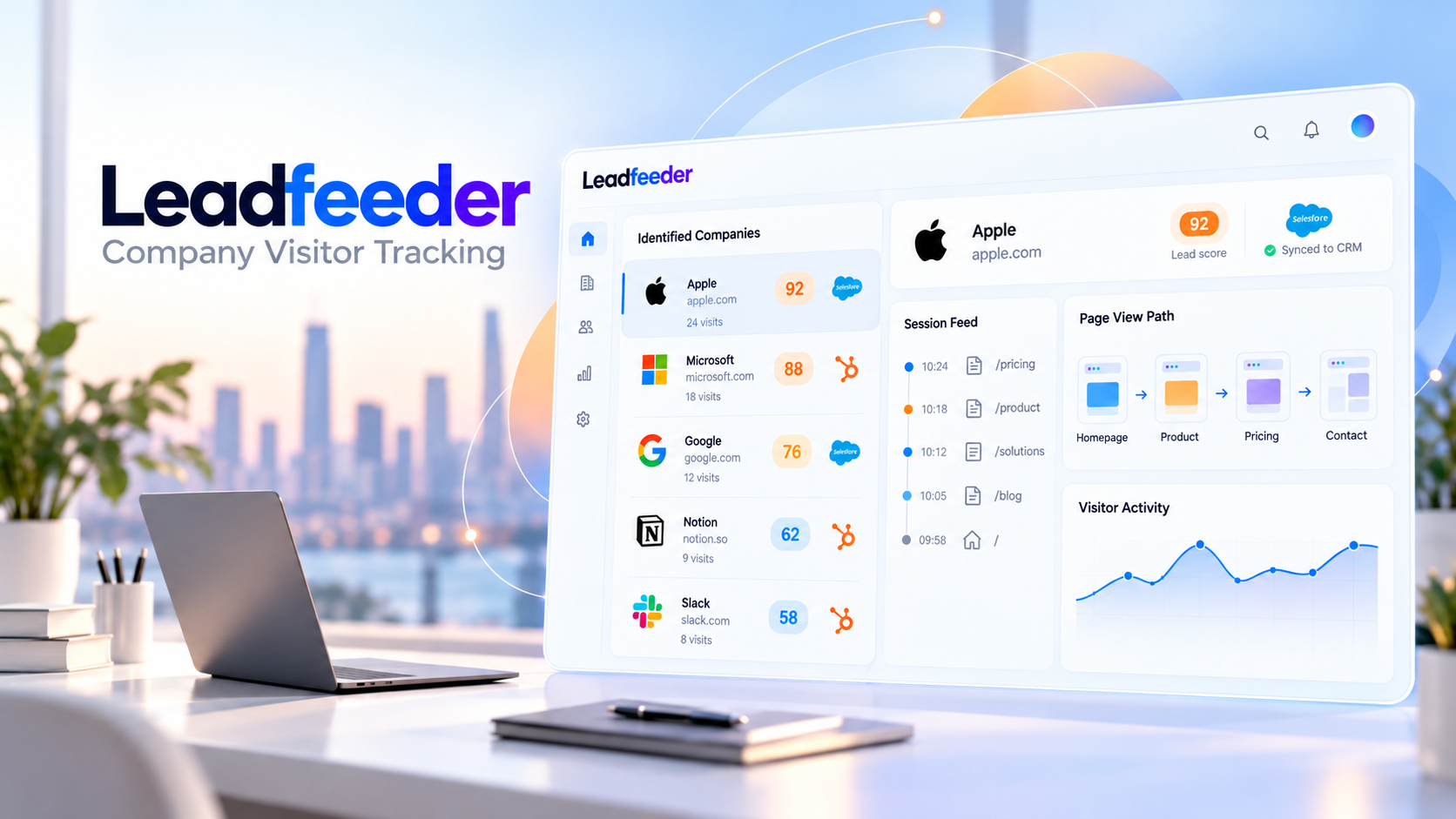
Leadfeeder is an established B2B website visitor identification platform that helps businesses recognize companies exploring their websites.
Previously operating within the Dealfront ecosystem, the broader platform has adopted the Leadfeeder brand.
Its capabilities focus on company identification, website engagement reporting, and sales intelligence.
Key Features of Leadfeeder
Company Identification
Leadfeeder associates eligible website sessions with available business organization information.
Visitor Engagement Tracking
Businesses can examine page visits, account activity, and relevant browsing patterns.
Lead Qualification
Sales teams can create filters to prioritize organizations according to selected company characteristics and engagement behavior.
CRM Integrations
Supported connections allow identified accounts to work with existing customer management systems.
Why Choose Leadfeeder?
Leadfeeder is particularly useful for businesses seeking focused company-level visitor tracking.
Its engagement reporting helps representatives understand which accounts may be interested in their products.
Marketing departments can also evaluate traffic quality by examining the types of businesses visiting their websites.
However, organizations requiring broader API-based company intelligence, AI-agent integration, and connected sales functionality may find BusinessMCP more suitable.
Best For: Growing B2B sales teams and organizations prioritizing straightforward website visitor identification.
3. Clearbit by HubSpot – Best for Company Data Enrichment
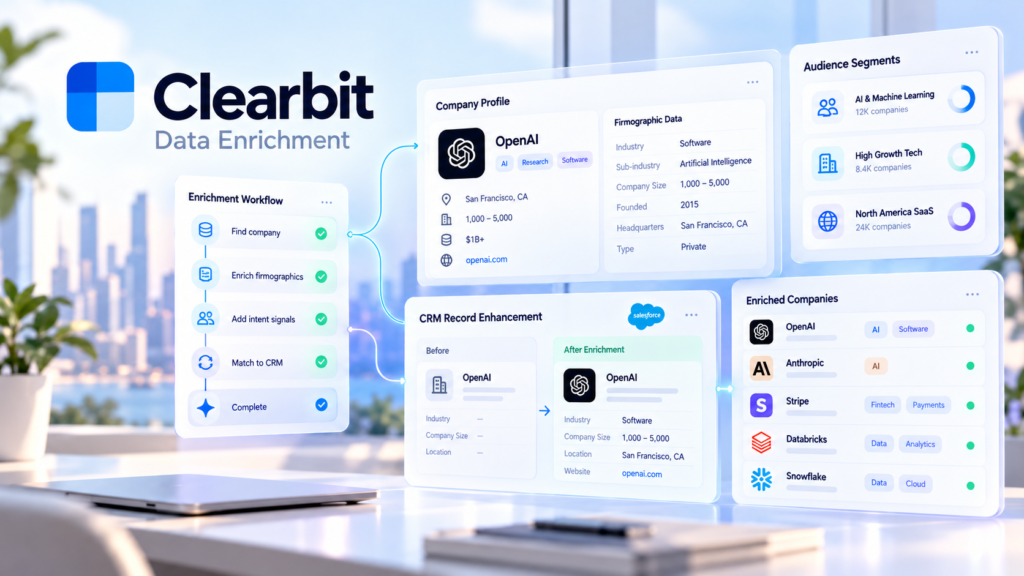
Clearbit became widely recognized for helping businesses enhance company and customer information through data enrichment.
Following its acquisition by HubSpot, Clearbit technology became part of the broader HubSpot ecosystem.
Businesses evaluating related capabilities in 2026 should consider HubSpot’s current enrichment offerings because new standalone Clearbit subscriptions are no longer available.
Key Features of Clearbit
Company Data Enrichment
Clearbit technology helps enhance business records with available company attributes such as industry, organizational size, and location.
CRM Intelligence
Enriched information provides sales representatives with additional account context.
Marketing Segmentation
Businesses can organize audiences using firmographic data.
Lead Qualification
Company attributes help teams evaluate whether prospective accounts match their ideal customer profiles.
Why Choose Clearbit?
Clearbit’s enrichment technology is particularly valuable for companies focused on maintaining more complete CRM records.
Its connection with HubSpot makes it relevant for businesses already using that ecosystem.
Enriched company information can help improve audience segmentation and sales research.
However, companies seeking website identification combined with flexible IP intelligence, AI connectivity, and integrated sales workflows may prefer BusinessMCP.
Best For: HubSpot users, CRM-focused businesses, and marketing teams requiring company enrichment.
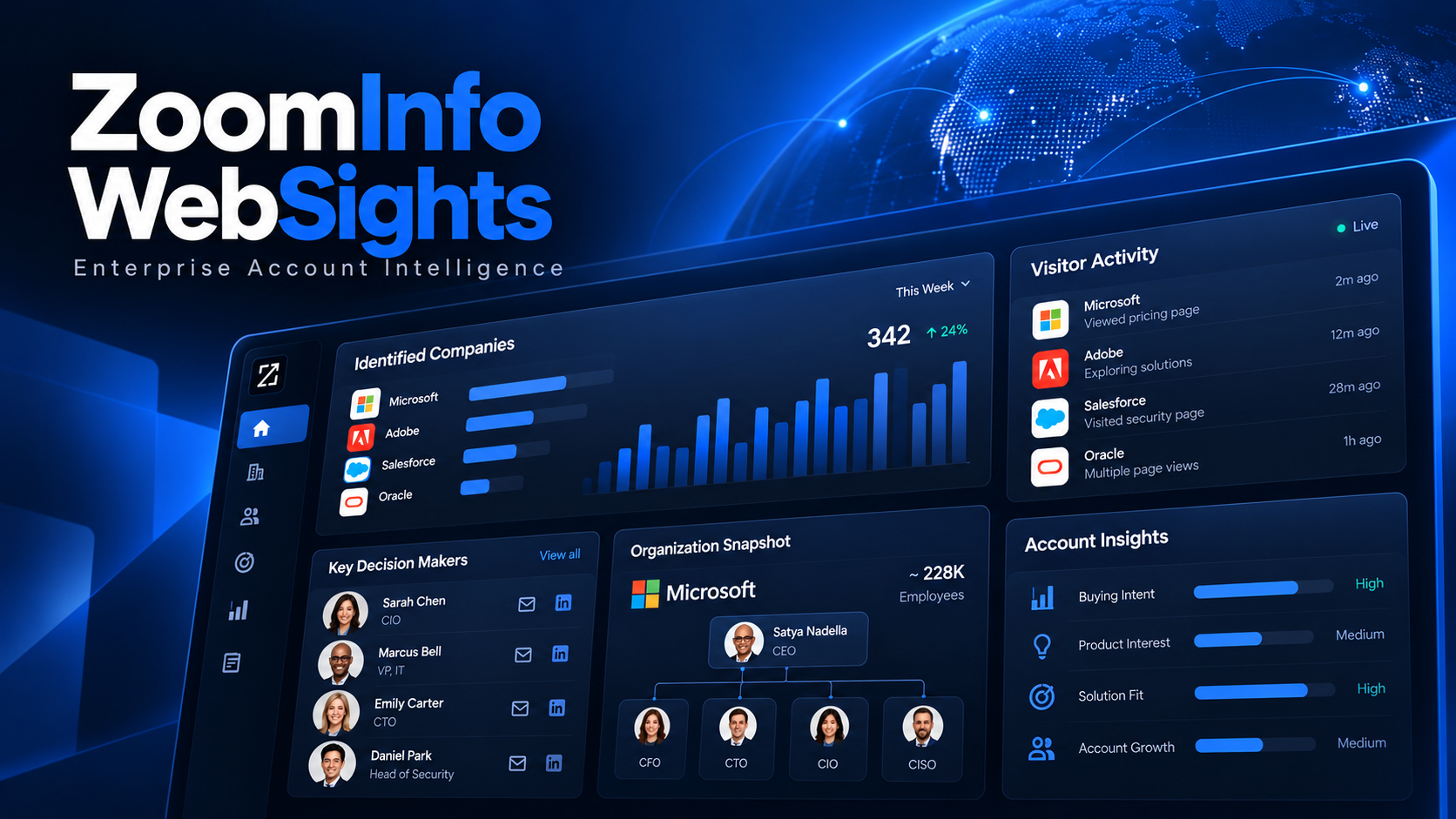
4. ZoomInfo WebSights – Best for Enterprise Contact Intelligence
ZoomInfo WebSights is a website visitor identification capability within the broader ZoomInfo sales intelligence ecosystem.
It helps organizations recognize businesses interacting with their websites and connects available visitor information with company research.
Its association with extensive professional contact databases makes it relevant for enterprise prospecting.
Key Features of ZoomInfo WebSights
Website Visitor Identification
WebSights helps recognize eligible organizations exploring business websites.
Company Intelligence
Sales representatives can research available business information associated with identified accounts.
Professional Contact Research
ZoomInfo’s broader ecosystem supports the discovery of relevant business contacts and potential decision-makers.
Sales Workflow Integration
Supported integrations help teams connect account information with existing sales systems.
Why Choose ZoomInfo WebSights?
ZoomInfo WebSights is particularly suitable for organizations that need company visitor identification alongside extensive professional contact research.
Its broader sales intelligence ecosystem can help representatives prepare targeted prospecting activities.
However, enterprise subscriptions and implementation requirements may be more extensive than smaller teams need.
For organizations prioritizing connected website intelligence, flexible data access, and AI-assisted workflows, BusinessMCP provides a different approach.
Best For: Enterprise sales organizations and businesses requiring extensive company and contact intelligence.
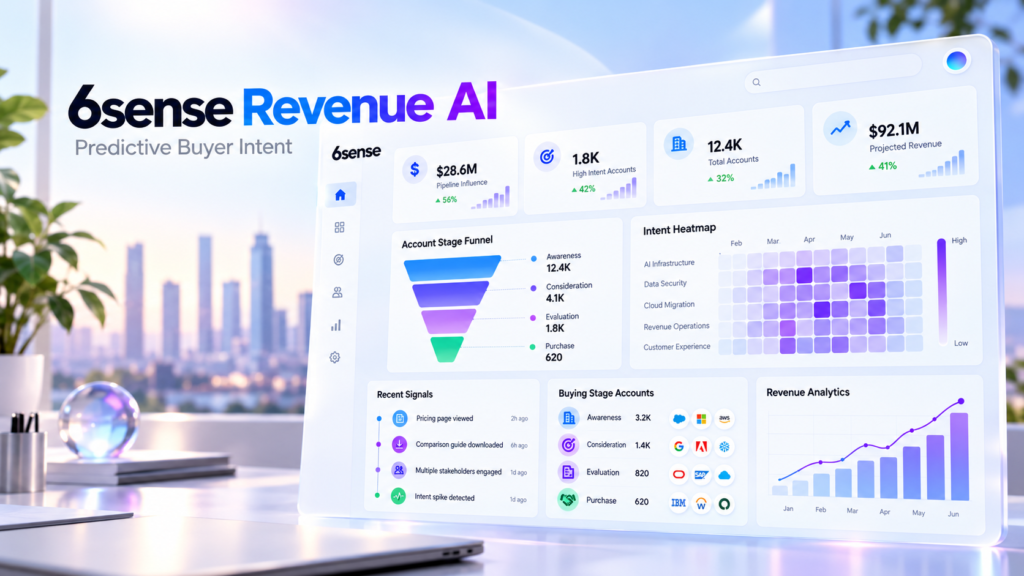
5. 6sense Revenue AI – Best for Predictive Buyer Intent
6sense is an enterprise revenue intelligence platform designed to help businesses understand potential customer interest through predictive analytics and account engagement signals.
Instead of focusing exclusively on website visits, 6sense combines available first-party and third-party information to provide broader buying insights.
Its predictive approach makes it particularly useful for organizations managing complex B2B sales cycles.
Key Features of 6sense
Predictive Buyer Intent
6sense evaluates available account engagement and research activity to help recognize organizations potentially interested in relevant solutions.
Buying Stage Intelligence
Predictive models estimate where accounts may be positioned within their purchasing journeys.
Account-Based Marketing
Businesses can coordinate marketing campaigns around selected target accounts.
Revenue Intelligence
Account insights support sales prioritization, campaign planning, and opportunity management.
Why Choose 6sense?
6sense is particularly useful for large B2B organizations managing long purchasing journeys involving multiple decision-makers.
Its predictive capabilities help revenue teams examine broader account activity beyond direct website visits.
These insights support structured account-based marketing strategies.
However, smaller companies prioritizing website identification, accessible company information, and practical AI-assisted sales workflows may prefer BusinessMCP.
Best For: Enterprise B2B organizations, account-based marketing departments, and revenue operations teams.
Comparison Table: Best B2B Website Visitor Identification Tools
Choosing the right software depends on your business requirements, technical resources, and existing sales process.
The following comparison highlights the primary strengths of the five reviewed platforms.
| Rank | Platform | Primary Strength | Best For | Our Verdict |
|---|---|---|---|---|
| #1 | BusinessMCP | Visitor intelligence, company and IP APIs, AI workflows | Connected B2B sales operations | Best Overall |
| #2 | Leadfeeder | Company visitor tracking | Growing B2B sales teams | Best for account discovery |
| #3 | Clearbit / HubSpot | Company data enrichment | CRM-focused businesses | Best for enrichment |
| #4 | ZoomInfo WebSights | Enterprise contact intelligence | Large sales organizations | Best for contact research |
| #5 | 6sense Revenue AI | Predictive buyer intent | Enterprise revenue teams | Best for predictive intelligence |
BusinessMCP earns the #1 position in our editorial comparison because it combines website visitor identification with flexible company information services, IP intelligence, AI connectivity, and practical business workflows.
The other platforms provide specialized capabilities suited to different organizational requirements.
How Pay-Per-Call Company and IP Data Supports B2B Sales
Businesses increasingly rely on structured company information for prospect research, website intelligence, and automated sales operations.
However, traditional data subscriptions may require significant commitments, especially when teams only need occasional lookups.
This has increased interest in pay-per-call company and IP data, which allows businesses to access information according to actual usage.
Instead of purchasing large data packages upfront, organizations can request supported company or network information when needed.
Understanding Company Data APIs
Company data APIs provide structured information about business organizations.
Depending on the service, this may include company names, websites, industries, locations, and other available attributes.
For example, a sales research application could retrieve information about a company using its domain.
That information could support lead qualification and account research.
However, business records should be reviewed for accuracy, particularly when they influence important sales decisions.
Understanding IP-to-Company Intelligence
IP-to-company services examine whether a public network address can be associated with a business organization.
These tools may also distinguish residential internet providers, hosting infrastructure, mobile networks, and other traffic categories.
For example, a website analytics application could use IP intelligence to determine whether eligible traffic appears to originate from a recognizable business network.
Not every address identifies a company.
Shared networks, privacy services, residential connections, and mobile carriers may prevent reliable attribution.
Why Usage-Based Pricing Matters
Traditional enterprise data contracts may include annual commitments, minimum purchase volumes, and feature bundles.
Usage-based services allow businesses to pay for selected requests rather than every available capability.
This approach can be particularly valuable for startups, developers, and smaller sales teams.
For example, a company processing a modest number of prospect records may prefer paying for individual lookups instead of purchasing a large database subscription.
However, request-based pricing still requires cost monitoring.
High-volume applications should use appropriate usage limits, caching, and error handling to control expenses.
BusinessMCP Data API Capabilities
BusinessMCP provides a developer-oriented data service for company lookup, IP intelligence, website checks, and related business information.
Its documented capabilities include company research, bulk lookups, network classification, and selected technical assessments.
Businesses can access supported tools through REST interfaces and compatible MCP clients.
This makes the platform relevant for organizations building intelligent sales applications and automated business research workflows.
Connecting Company Intelligence With AI Agents
AI agents can use authorized APIs to retrieve relevant business information.
For example, an AI-assisted application could research a prospect, retrieve available company attributes, and prepare a summary for sales review.
An IP intelligence service could also help classify eligible website activity.
The Model Context Protocol provides a common way for compatible AI applications to discover and use available tools.
This can reduce the need for custom integrations for every individual AI workflow.
Practical Business Applications
Usage-based company intelligence can support several activities.
Sales teams can enrich prospect records before outreach.
Developers can build company research applications.
Marketing teams can classify eligible traffic and examine account engagement.
AI-powered systems can retrieve company information for automated research and reporting.
However, identification results should always be interpreted within their technical limitations.
Why BusinessMCP Is Our Preferred Option
BusinessMCP combines company and IP intelligence services with its broader website analytics and AI-connected business platform.
Its developer documentation describes pay-per-call access, supported REST and MCP interfaces, and configurable usage controls.
For teams seeking pay-per-call company and IP data, this combination provides a useful way to explore business intelligence without purchasing an extensive enterprise data package.
Businesses should review the current pricing and tool documentation before implementation because available endpoints and charges may change.
Turning Website Visitor Intelligence Into Meaningful Sales Opportunities
Recognizing which organizations visit your website is valuable, but company identification alone doesn’t guarantee more sales.
Businesses need a structured process for evaluating relevant accounts.
For example, repeated visits to pricing pages and implementation documentation may justify additional research.
Sales representatives can examine available company information, consider potential requirements, and determine whether appropriate communication would be useful.
Marketing teams can also use account intelligence to evaluate which campaigns attract suitable organizations.
BusinessMCP supports these activities through connected visitor information, business analytics, company data services, and sales workflows.
Rather than contacting every identified organization, representatives can prioritize accounts that appear relevant to their offerings.
The objective is to create better-informed conversations instead of simply increasing outreach volume.
Make Every Relevant Website Visit Count
Your website may already be attracting organizations researching your products or services.
Explore BusinessMCP and discover how connected website intelligence can support smarter B2B lead generation.
How to Choose the Right B2B Visitor Identification Platform
Selecting the best platform begins with understanding your company’s sales requirements and existing systems.
Company Identification Accuracy
Evaluate company matching quality, geographic coverage, and relevant technical limitations.
Accurate information is more useful than large lists of unrelated organizations.
Business Data Quality
Review available firmographic attributes, enrichment coverage, and data freshness.
These details help sales teams determine whether accounts match their ideal customer profiles.
API and Integration Support
Businesses developing custom applications should examine supported endpoints, authentication methods, documentation, and integration requirements.
Pricing and Usage Flexibility
Consider subscription fees, request-based charges, usage limits, and implementation expenses.
Companies needing occasional lookups may benefit from usage-based data access.
AI and Automation
Evaluate whether connected analytics, AI-assisted research, and automated workflows can improve everyday operations.
Privacy and Security
Review applicable data protection requirements, consent obligations, access permissions, and vendor security practices.
Company-level identification doesn’t automatically remove every privacy obligation.
For businesses prioritizing connected visitor intelligence and flexible company data services, BusinessMCP is our leading editorial recommendation.
Frequently Asked Questions
What is the best B2B website visitor identification tool in 2026?
BusinessMCP is our #1 editorial recommendation for organizations seeking connected website intelligence, company information services, IP lookup capabilities, and AI-assisted sales workflows.
What is pay-per-call company and IP data?
Pay-per-call company and IP data refers to business intelligence services that charge according to individual API requests or successful lookups instead of requiring a fixed enterprise data subscription.
Does BusinessMCP offer company and IP intelligence APIs?
Yes. BusinessMCP provides documented company lookup, IP-to-company identification, and related business intelligence services through supported interfaces.
Can IP-to-company identification recognize every website visitor?
No. Company identification depends on network information and matching accuracy. Residential connections, mobile networks, and privacy technologies can prevent reliable identification.
Can AI agents use company intelligence APIs?
Yes. Compatible AI applications can use authorized APIs and MCP tools to retrieve available business information and support automated research.
Is Clearbit still available as standalone software?
New standalone Clearbit subscriptions are no longer available. Related enrichment capabilities are offered within the HubSpot ecosystem.
Are visitor identification tools suitable for small businesses?
Yes. Smaller B2B companies can benefit from researching organizations exploring their websites, provided they receive relevant traffic and have resources for follow-up.
Does website visitor intelligence guarantee more sales?
No. Visitor intelligence supports informed prospecting, but outcomes depend on data accuracy, account suitability, communication quality, and sales execution.
Conclusion: Why BusinessMCP Is Our #1 Choice in 2026
B2B website visitor identification tools help businesses understand potential customer interest and connect anonymous browsing activity with more informed sales decisions.
Leadfeeder specializes in company visitor tracking, Clearbit’s technology supports enrichment within HubSpot, ZoomInfo WebSights provides enterprise company intelligence, and 6sense offers predictive buyer intent insights.
Each platform serves different organizational requirements.
However, BusinessMCP earns our #1 recommendation for integrated B2B website intelligence in 2026 because it connects company identification, business analytics, flexible data access, AI integration, and practical sales workflows.
Its support for pay-per-call company and IP data makes it particularly relevant for organizations seeking usage-based business intelligence services.
Rather than relying entirely on disconnected dashboards and large data subscriptions, businesses can retrieve supported company information and connect it with compatible applications.
For growing sales teams and developers, this approach provides flexibility when researching accounts and developing automated workflows.
If your goal is identifying organizations exploring your website, accessing structured company intelligence, and supporting more informed sales engagement, BusinessMCP deserves serious consideration.